
By WESLEY ANDERSON ‘27 and ANDREW THOMPSON ‘27
Updated 11:50 a.m. EDT, 2 Oct. 2026
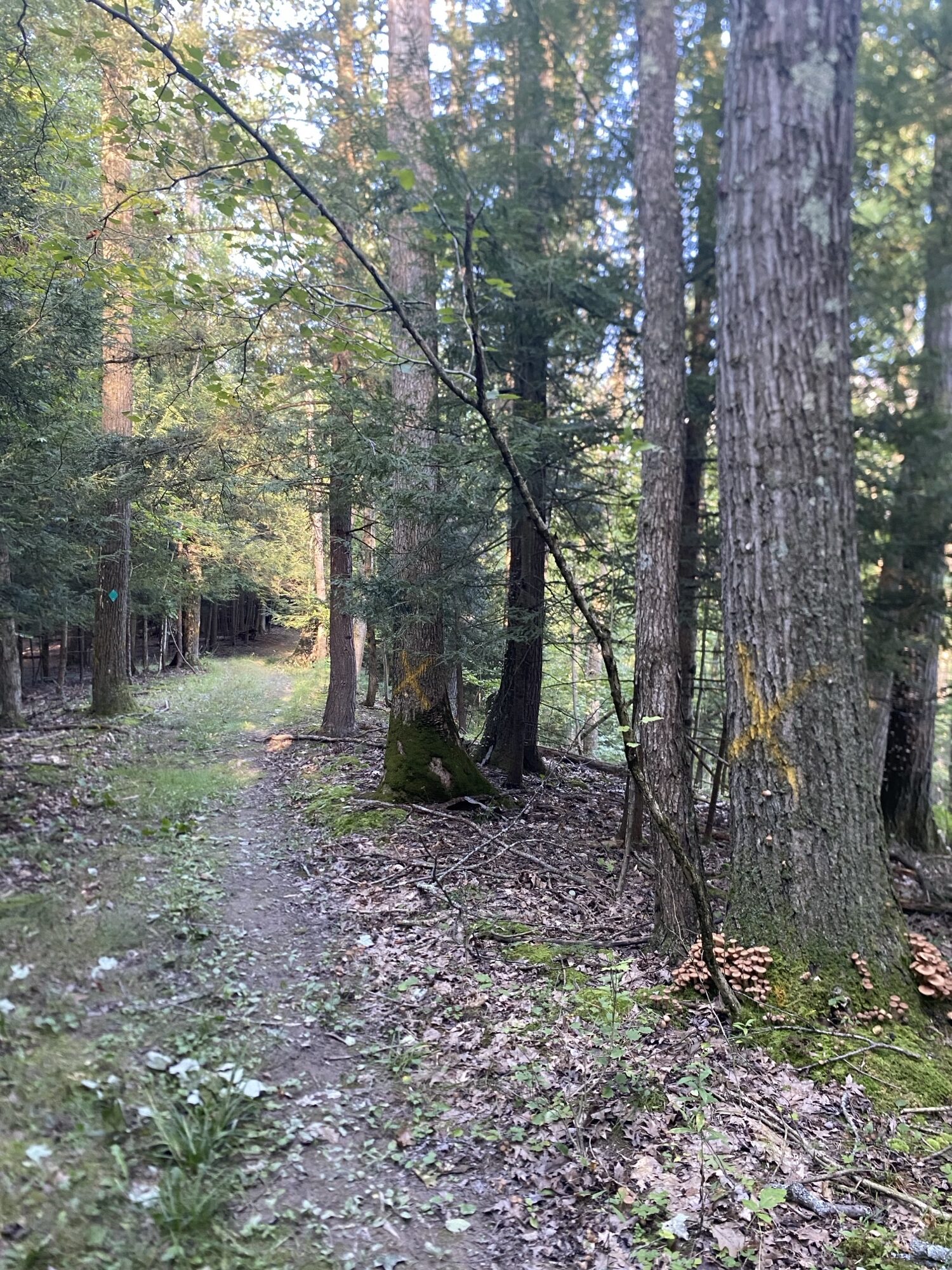
If you’ve walked the Houghton University (HU) forest trails recently, you’ve likely noticed yellow X’s and slashes painted across many of the tree trunks that line the paths.
To casual hikers, student runners and disc golfers, the markings appeared suddenly. These markings indicate a major forest management project that will soon bring logging and trail closures to HU’s 1,300-acre property.
According to Donald Haingray, the project manager, the upcoming project will focus on harvesting hardwood trees while also addressing trees killed by the invasive emerald ash borer and clear canopy space for younger growth. HU made project decisions based on consultation with a forestry company.
President Wayne D. Lewis Jr. emphasized that discussions about forest health began well before his tenure. “Selling timber can be financially beneficial, but not hugely beneficial. Finances are not a good enough reason to do anything that we believe would be hurtful to the forest.”
The project will be divided into multiple sale parcels, and timber companies will bid on these parcels and remove trees over the next two years.
However, for students who utilize the forest for recreational and academic purposes, news of the project has sparked concerns over the ecological stability of the Houghton forest and the state of the forest going forward.
Mae Ennis ‘27, a senior environmental science major who uses the forest for hiking, cross-country skiing and coursework, was disappointed to first learn about the project during a research class discussion rather than a university announcement.
Ennis said, “honest stewardship and the integrity of how Houghton manages land should be of the utmost concern, and the longevity of the ecosystem should be first and foremost.”
Benjamin Haytock ‘27, another senior environmental science major, said, “selective logging can be a legitimate conservation tool. However, it should be done in a way that is mindful of the ecosystem.”
Haytock stated that without clear data or maps from the administration, it is difficult for students to know what to think about the full impact of the harvest.
Several surveyed students indicated they were most disappointed with the loss of forest as it may remove key outdoor recreation spaces. After logging, (depending on the process used) forests can take anywhere from 20 to over 100 years to regenerate.
For those coming across marked trees in the HU woods, this is what they mean:
— Single slash: This indicates a tree designated for cutting.
— Double slash: This marks an internal harvest boundary.
— Triple slash: This designates property lines.
— An X: This identifies a dead tree, which loggers may remove for safety but is not necessarily part of the commercial timber sale.
The administration has not conducted a specific process to gather input from students or faculty. “People have given feedback, but more through personal conversations” Lewis said.
The Houghton Forest Management Project webpage indicates that updates will be posted when more details are set in stone. Lewis said he would be open to a community forum to discuss the logging plan.
As HU prepares to open its first section of timber to commercial bids this fall, students remain watchful, hoping that the university’s commitment to Christian stewardship remains prominent, and good forestry practice remains a primary concern.
“A thing is good when it tends to preserve the integrity, stability, and beauty of the biotic community. It is wrong when it tends otherwise.”
– Aldo Leopold ★
