By SALIM FORD ’28
Updated 11:50 a.m. EDT, 14 Nov 2025
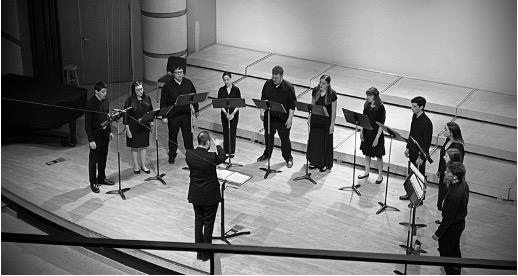
On Saturday, Nov. 15, at 7:30 p.m., the Houghton University Chamber Choir will present its first recital of the year at Houghton Wesleyan Church, titled “Monuments.” The performance features staples of choral works from the Renaissance and the 21st century. Chamber Choir Director Dr. Kevin Dibble described his programming process: “I wanted to pick things that were appropriately challenging, that would stretch us, that would grow us, that were beautiful, and that the audience would appreciate.”
The recital begins with Gregorio Allegri’s “Miserere Mei, Deus”. The piece is a setting of Psalm 51, and features a famously high soprano melody. Dibble described the piece as “One of [his] all-time favorites” and something he hasn’t been able to sing or conduct before, aside from this year’s Collage Concert.
Following this renowned, haunting choral work comes Giovanni Pierluigi da Palestrina’s “Stabat Mater”. This year marks the 500th anniversary of Palestrina’s birth, and the Chamber Choir will celebrate by singing one of his final compositions. “Stabat Mater” features a double choir, presenting a challenge for the Chamber Choir, with one or two singers on a part.
Dominic Larson ‘27, a tenor beginning his second year in Chamber Choir, recounted an evening rehearsal where the piece came together: “That night, it became clear that this group is really, really special.” He described the double choir as “something [he’s] never been a part of or seen in [his] life.”
Finally, the concert will close with Arvo Pärt’s “Berliner Messe”. Larson spoke to the challenges of the eight-movement mass: “There’s a lot of jumps, a lot of chaos.” However, he’s “really excited to see how it turns out.” Dibble characterized the Holy Minimalist composer: “Pärt is very text-based; he’s very introspective.” He said that, despite centuries separating Pärt from the composers of the Renaissance, “There’s a lot of crossover … in the way they approach vocal ideas and the way that composers approach setting the text and telling the story.” Larson likewise spoke to their similarities: “They’re all sacred pieces that are longer. [There’s] more of a cohesive theme between all three of the pieces than we normally would have.”
Dibble spoke movingly about his hopes for the recital: “My goal for this concert is to take the audience for an hour out of the rapidity of social media and the anger of politics and division of our country and our world and put us all in this space of calm, peaceful, reflective prayer.”
The Chamber Choir worked hard to bring together the inherently challenging melodies and harmonies of the Renaissance and the Holy Minimalism Movement — momentous eras, each in its own right. You are invited (free of charge) to enjoy three monumental pieces that create a space for introspection and prayer.★